
Point Cloud & Drone LiDAR Scanning
Point Clouds and LiDAR Data for Construction, Land and Project Planning
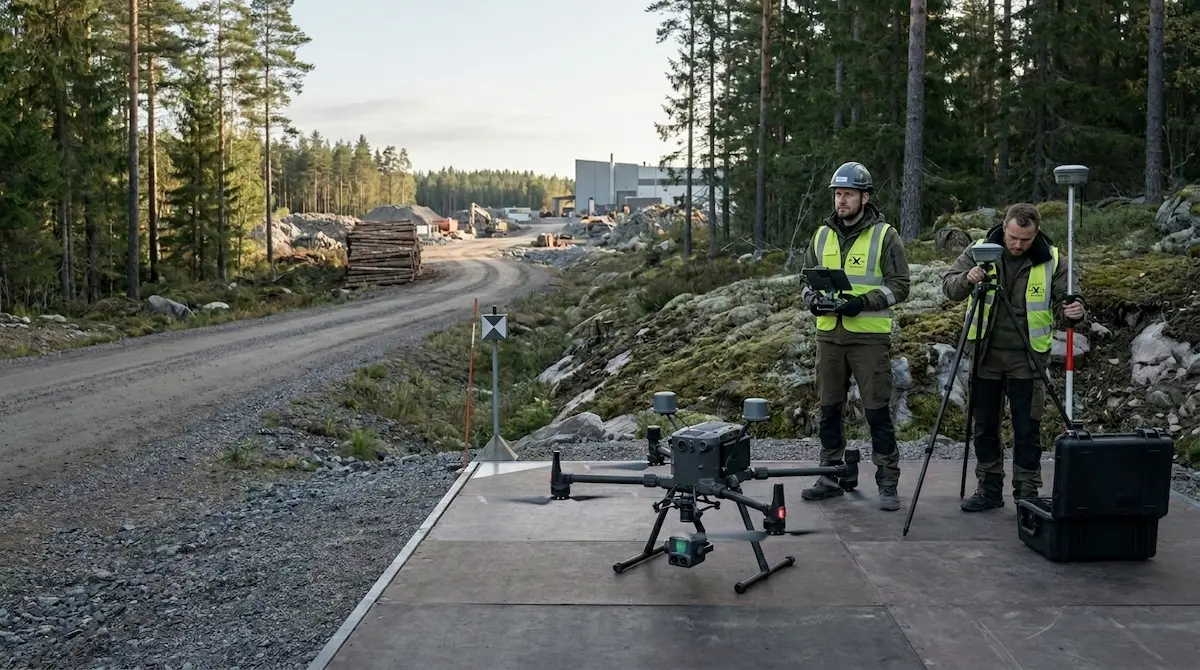
Drone LiDAR scanning is an efficient method for collecting detailed 3D data of terrain, vegetation, construction areas, infrastructure and other environments where ordinary images are not enough as technical documentation. With LiDAR, the drone measures distances using laser pulses and creates a point cloud that describes the shape, elevation differences and structures of an area in three dimensions.
The result is a digital dataset that can be used for analysis, project planning, documentation, terrain modelling, volume calculations and further processing in technical software. Drone LiDAR scanning is especially useful in areas with vegetation, uneven terrain or hard-to-access surfaces where traditional surveying can be time-consuming.
We provide drone LiDAR scanning across Sweden and can support companies, contractors, project managers, landowners and consultants in Stockholm, Gothenburg, Malmö, Uppsala, Västerås, Örebro, Linköping, Norrköping, Jönköping, Gävle and other regions depending on the needs of the project.
What Is Drone LiDAR Scanning?
Drone LiDAR scanning means that a drone equipped with a LiDAR sensor flies over an area and collects laser data from the air. The sensor sends out laser pulses and measures how long it takes for the signals to return. This creates a large number of measured points that together form a point cloud.
A point cloud can describe ground levels, vegetation, buildings, slopes, roads, stockpiles, ditches, utility corridors and other objects in the area. Unlike a standard aerial image, LiDAR data is not dependent on the same visual texture in the image. This makes LiDAR especially useful in environments where vegetation, shadows or low-texture surfaces can limit the results of photogrammetry.
Drone LiDAR scanning is often used as part of professional surveying, mapping and technical documentation when the client needs more than a visual overview.
Point Clouds as Technical Documentation
A point cloud is a digital 3D dataset made up of a large number of points with position and elevation. Each point represents a measurement in space. Together, the points create a detailed representation of the area and can be used to analyse height, shape, surfaces and volumes.
Point clouds from drone LiDAR scanning can be used as a basis for several types of projects. This can include terrain models, ground level analysis, vegetation analysis, documentation before construction work or data for technical planning.
In many projects, the point cloud is not the final product by itself. It is the foundation for further work. From LiDAR data, it is possible to create terrain models, elevation models, sections, profiles, volume calculations or visualisations that help the client make better decisions.
When Is LiDAR Better Than Photogrammetry?
Photogrammetry and LiDAR are two different methods that can complement each other. Photogrammetry is based on overlapping images and is very useful for orthophotos, 3D models and visual documentation. LiDAR is based on laser data and is often more suitable when the focus is elevation data, terrain, vegetation and measured points.
Drone LiDAR scanning is especially useful when the area includes:
- vegetation or forest
- large elevation differences
- hard-to-access terrain
- need for terrain models or elevation data
- requirements for point clouds in LAS or LAZ
- technical documentation for project planning
- stockpiles, masses or surfaces that need to be analysed
- areas where standard aerial images do not provide enough information
For many projects, LiDAR can be combined with RGB images, orthophotos or other documentation. This gives the client both technical LiDAR data and visual material from the same project.
Use Cases in Construction, Land and Infrastructure
Drone LiDAR scanning can be used for many different types of assignments. In construction and land development, LiDAR data can be used to document existing conditions, create a basis for planning or monitor changes over time.
For infrastructure projects, point clouds can help describe roads, slopes, ditches, utility corridors, work areas and surrounding terrain. In forestry and natural environments, LiDAR can be useful because laser pulses can in some cases provide information about ground levels even where vegetation is present.
Common use cases include:
- terrain modelling
- point clouds for project planning
- documentation of land areas
- analysis of vegetation and terrain
- volume calculations for masses and stockpiles
- elevation data for construction and civil engineering projects
- control of slopes, surfaces and level differences
- data for CAD, GIS and further technical processing
Delivery: LAS, LAZ, DTM, DSM and Elevation Data
The delivery is adapted to the purpose of the project and the client’s workflow. Some projects require a raw point cloud for further processing. Other projects need more processed products such as terrain models, elevation models or report-ready documentation.
Examples of deliverables from drone LiDAR scanning include:
- point cloud in LAS format
- point cloud in LAZ format
- classified point cloud when required
- digital terrain model, DTM
- digital surface model, DSM
- elevation data
- sections or profiles
- data for volume calculations
- high-resolution images as a complement
- digital delivery through a secure link
We can also adapt the delivery depending on whether the material will be used in GIS, CAD, project planning software or other technical programs.
Accuracy, RTK and Coordinate Systems
The accuracy of drone LiDAR scanning depends on several factors, including flight altitude, flight speed, GNSS/RTK solution, sensor quality, terrain, vegetation and post-processing workflow. For professional projects, it is important to plan the flight based on how the data will be used.
When needed, the work can be carried out with RTK, control points and adaptation to relevant coordinate and height systems. In Sweden, SWEREF 99 and RH 2000 are commonly used in technical contexts. This makes it important to define early which system the client needs the data in.
We help you choose a reasonable level of accuracy based on the project requirements. Not every assignment needs the same measurement standard, but when the data will be used for project planning, construction, volume calculations or technical analysis, a more controlled workflow is required.
Drone LiDAR Scanning Across Sweden
We offer drone LiDAR scanning across Sweden. Assignments can be carried out in larger cities such as Stockholm, Gothenburg, Malmö, Uppsala and Västerås, but also in smaller towns, forest areas, infrastructure projects, industrial sites and land development areas where there is a need for accurate 3D data.
Because every site has different conditions, each project is planned individually. We review the area, terrain, airspace, safety, required delivery, accessibility and any need for permits or specific operational planning.
Whether you need drone LiDAR scanning for a land project in Gothenburg, a construction project in Stockholm, a forest area in Uppsala or an infrastructure project in another part of Sweden, we can create a workflow adapted to the assignment.
Regulations, Dissemination Permits and Data Handling
When collecting aerial LiDAR data, images or other geographic material with drones, the assignment must be planned according to applicable rules. If the material is to be shared, published or sold, a dissemination permit may be required in Sweden.
This does not only apply to standard aerial images. It may also apply to laser data, elevation data and other geographic material collected from the air. For that reason, data handling, storage and delivery should be considered before the assignment is carried out.
We work with structured planning, safety and data handling so that each assignment can be carried out in a professional way.
LiDAR Data and Dissemination Permits
When LiDAR data, elevation data, aerial images or other geographic material collected by drone is to be shared, published or sold, a dissemination permit may be required in Sweden. This is why it is important that the material is handled correctly from planning to delivery.
Lantmäteriet provides official information about dissemination permits for aerial images, videos, laser data, elevation data and other geographic material collected from the air.
External link:
Read more about dissemination permits at Lantmäteriet
Technical Guidance for Aerial Laser Scanning
For those who want to read more about technical principles, quality and workflows for aerial laser scanning, Lantmäteriet provides HMK material about aerial laser scanning.
Read more about HMK – Aerial Laser Scanning at Lantmäteriet
Need Drone LiDAR Scanning?
Contact us if you need point clouds, LiDAR data, terrain models or elevation data for construction, land projects, infrastructure, forestry, project planning or technical documentation.
We review the area, the purpose of the data, the required accuracy and which delivery format is most suitable for your project.