
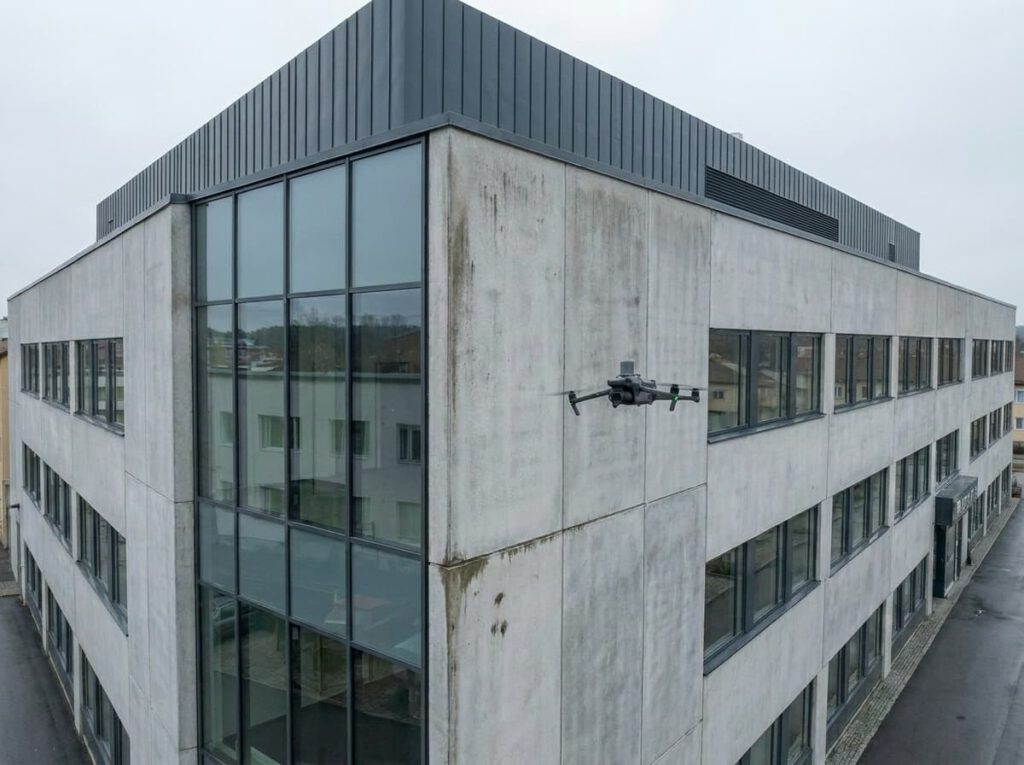
Façade Inspection with Drone
Visual and Thermal Façade Inspection for Buildings and Properties
Façade inspection with drone is an efficient way to document façades, glass sections, joints, cracks, damage and hard-to-reach parts of a building. With drones, we can collect detailed images and video from angles that would otherwise require lifts, scaffolding or time-consuming manual access.
We provide both visual façade inspection and thermal façade inspection with drone. The visual inspection is used to document visible damage, wear, cracks, paint defects, joints, sheet metal, glass façades, balconies and other façade details. Thermal inspection can be used when you need to investigate temperature differences, heat loss or abnormal areas that may require further review.
We offer façade inspection with drone across Sweden and can carry out assignments in Stockholm, Gothenburg, Malmö, Uppsala, Västerås, Örebro, Linköping, Norrköping, Jönköping, Gävle and other regions depending on the needs of the project.
When Is Façade Inspection with Drone Used?
Façade inspection with drone is used when property owners, housing associations, construction companies, facility managers, technical consultants or insurance companies need clear documentation of a building façade.
It can be used for recurring maintenance, documentation before renovation, inspection after damage, review of hard-to-reach areas, inspection of glass façades or follow-up after completed work.
Drones are especially useful for tall buildings, courtyards, façades with limited access or locations where lifts and scaffolding involve higher cost, longer planning or more disruption to the surrounding activity.
Common use cases include:
- documentation of façades before renovation
- inspection of cracks, damage and wear
- inspection of glass façades and window sections
- documentation of plaster, brick, concrete, sheet metal and façade panels
- inspection of joints, connections and details
- inspection of balconies, railings and façade-related structures
- thermal inspection of abnormal temperature patterns
- documentation for maintenance planning, quotations or technical assessment
Visual Façade Inspection with Drone
A visual façade inspection with drone focuses on high-resolution images and video of the different parts of the façade. The purpose is to create clear documentation that makes it easier to review the façade condition and identify areas that may need closer inspection.
During a visual inspection, the drone can document details that are difficult to see from ground level. This can include cracks, glass damage, joint wear, paint defects, discolouration, damage around windows, defects in sheet metal work or other visible deviations.
The material can be used by property owners, technical consultants, contractors or specialists as a basis for further assessment. A drone inspection does not always replace a physical survey, but it can provide strong visual documentation before deciding on the next step.
Thermal Façade Inspection with Drone
Thermal façade inspection with drone is used when you need to document temperature variations on a façade or around the external parts of a building. With a thermal camera, the drone can show patterns that are not always visible in standard images.
Thermography can be relevant when there is suspicion of heat loss, poor insulation, thermal bridges or other deviations that require further review. However, the result is affected by weather, wind, solar radiation, material type, time of day and building construction. Thermal images must therefore always be interpreted with the right level of caution.
Thermal façade inspection can be used as an initial technical basis. When needed, the material can be complemented with physical inspection, energy analysis, moisture measurement or assessment by a specialist in construction, energy or façades.
What Can Be Documented?
A façade inspection with drone can be adapted to the building type, façade material and purpose of the assignment. Some projects focus on the overall condition of the façade, while others require detailed documentation of specific areas.
Examples of what can be documented:
- cracks in plaster, concrete or brick
- paint defects, discolouration and wear
- damage in glass façades or window sections
- joints, connections and seals
- façade panels, sheet metal and cladding
- balconies, railings and fixings
- water runoff and visible moisture indicators
- damage caused by weather, wind, ice or external impact
- details before renovation or maintenance planning
For glass façades, drones can be used to document damage, cracks, scratches, uneven areas or other visible deviations without needing to access every glass section manually.
Benefits of Drone Façade Inspection
Façade inspection with drone provides fast and flexible access to image material from high and hard-to-reach parts of a building. It can reduce the need for lifts, scaffolding or other access equipment during the first stage of documentation.
Another benefit is that the material can be saved and compared over time. This makes it easier to monitor the development of damage, plan maintenance and communicate with contractors, consultants or insurance companies.
Benefits of façade inspection with drone:
- fast documentation of large façade areas
- reduced need for lifts or scaffolding during initial inspection
- high-resolution images and video from relevant angles
- possibility of thermal documentation when needed
- clear basis for further technical assessment
- easier communication between property owner, consultant and contractor
- possibility to monitor changes over time
- digital delivery that can easily be shared with relevant parties
How the Process Works
Each assignment starts with a review of the building, façade material, purpose of the inspection and type of documentation required. The flight is then planned based on site conditions, airspace, safety, weather, privacy and applicable regulations.
For visual façade inspection, we collect images and video from relevant angles and distances. For thermal façade inspection, timing and conditions are planned more carefully, since thermal images are affected by the surrounding environment.
After the flight, the material is structured so the client can easily review the different parts of the façade. When needed, the delivery can be divided by façade side, building section, height, area or type of deviation.
Delivery and Documentation
The delivery is adapted to the scope of the assignment and the client’s needs. For some projects, images and video files are enough. For other projects, the client may need marked images, overviews, thermal images or a simple report.
Examples of delivery:
- high-resolution images
- video documentation of façades
- thermal images for thermal inspection
- overview images and detail images
- marked images showing visible deviations
- simple report or image appendix
- structured delivery by façade or building section
- digital delivery through a secure link
The material can be used as a basis for further assessment, quotation requests, renovation planning, insurance matters or technical documentation.
Façade Inspection with Drone Across Sweden
We provide façade inspection with drone across Sweden. Assignments can be planned in larger cities such as Stockholm, Gothenburg, Malmö, Uppsala and Västerås, but also in smaller towns where property owners, companies or organisations need professional façade documentation.
Whether you need façade inspection with drone for a property in Stockholm, a glass façade in Gothenburg, a housing association in Malmö, a commercial building in Uppsala or an industrial project in another part of Sweden, we can adapt the workflow to the building and the purpose of the inspection.
Rules, Safety and Responsibility
Drone flights close to buildings require careful planning. We consider airspace, people nearby, the building location, weather conditions and on-site safety. For certain assignments, specific permits or additional planning may be required.
It is also important to remember that a façade inspection with drone is documentation and decision support. If there is suspicion of serious structural defects, moisture damage or other building-related problems, the material should be complemented with physical inspection or assessment by a relevant professional when needed.
External Information About the Building Owner’s Responsibility
Building owners are responsible for maintaining buildings so that important technical properties are preserved. This also applies to the external parts of the building, where façades, roofs and other structures may need to be inspected and maintained over time.
Boverket provides information about the building owner’s responsibility under Swedish planning and building legislation.
Read more about the building owner’s responsibility at Boverket
Need Façade Inspection with Drone?
Contact us if you need visual or thermal façade inspection with drone for a property, building, glass façade, housing association, industrial facility or technical documentation.
We review the building, the purpose of the inspection and which type of delivery is most suitable.